
%20(1).avif)
By Alex Will, Founder of Beckon
What is office decommissioning? It is the work of closing out a leased commercial space after your team has left. Furniture and equipment come out, anything that cannot go in the trash is handled correctly, and the space returns to your landlord in the condition your lease requires. Most companies meet it when they move, downsize, consolidate locations, or close an office. It is usually the last item on the plan, and the one with a hard deadline attached.
This guide explains what office decommissioning includes, what your lease requires, and how to plan it in San Diego so the old space closes out as cleanly as the new one opens.
Clear it. Close it out. Move on.
What happens to an office after everyone leaves
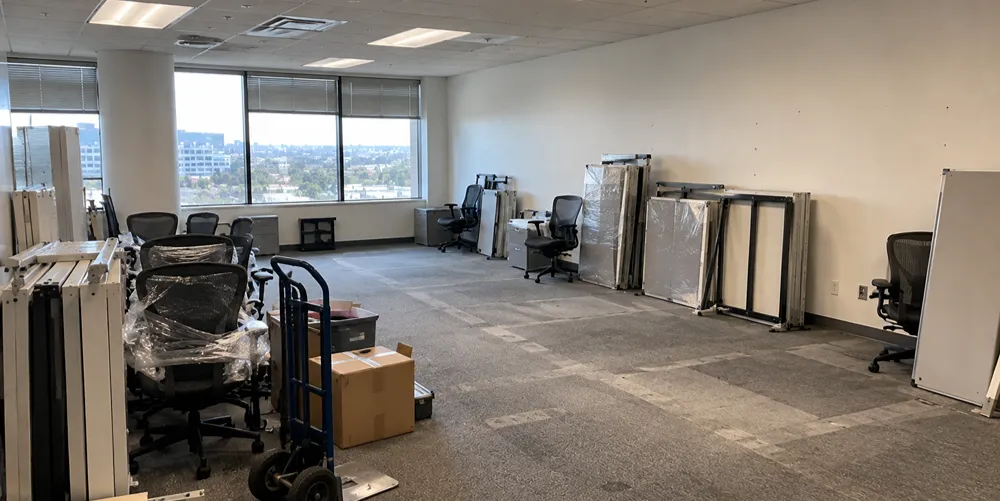
So what is office decommissioning in practice? It is everything that happens to a space after your people leave and before the landlord takes it back. A move carries what you are keeping to the new office. Decommissioning handles everything else: the furniture, fixtures, and equipment (FF&E) staying behind, the technology that needs careful handling, and the space itself.
You will also hear it called end of lease office cleanup, lease exit, move-out, or lease turnover. The names differ and the job is the same. At the low end, a lease asks for a "broom clean" space, which means vacant, cleared of debris, and swept. At the high end, it asks for the improvements you built to be removed and the space restored. Either way, the work ends with a landlord walk-through, and that walk-through is the test.
Most of what you need to do follows from one document, your lease.
Why companies decommission an office
- Downsizing. The team needs less space than the lease provides.
- Consolidating. Two locations become one.
- Relocating. The company moves and the old space has to be handed back.
- Closing a location. The space is no longer part of the plan.
- Adjusting to hybrid work. Many companies now hold more space and furniture than their schedules use.
In every case, a lease end date sets the clock.
Decommissioning, relocation, and liquidation
These three terms get mixed up, and they describe different jobs.
- Relocation moves your people, furniture, and technology into the new space.
- Decommissioning closes out the space you are leaving, from furniture removal to the final walk-through.
- Liquidation is the part of decommissioning that sells or redistributes furniture and equipment you are not keeping, a form of asset recovery that can offset part of the cost.
A good plan treats all three as one project on one schedule.
What the work includes
The scope depends on the space and the lease, but most projects cover four areas.
Furniture and equipment
- Inventory every workstation, chair, table, storage unit, and appliance before anything moves.
- Decide what goes to the new office, what gets resold, what is donated, what is recycled, and what is disposed of.
- Disassemble and remove it all, including pieces attached to walls or floors.
- Schedule removal around the building's freight elevator, loading dock, and hours.
Technology, e-waste, and data
- Retire or relocate computers, phones, printers, and AV equipment.
- Send electronics to a recycler instead of the dumpster. California treats much of this e-waste as universal waste (more on that below).
- Ask for a certificate of destruction on hard drives and documents that hold sensitive information.
Cabling, signage, and restoration
- Remove your signage and anything attached to the building that the lease says must go.
- Pull abandoned data and telecom cabling where the lease requires it.
- Take out built walls, glass partitions, or breakroom additions if the lease calls for it.
- Patch, repair, and repaint wherever removal leaves marks. This is the restoration part of the job.
Cleaning and the final walk-through
- Clean the space to the standard the lease sets.
- Photograph the condition before, during, and after the work.
- Walk the space with the landlord or property manager, and get the handover confirmed in writing.
An empty office has not passed until the landlord says it has.
Why decommissioning deserves its own plan
Office decommissioning is the one part of a move with a written standard, a fixed deadline, and a landlord who checks the result. That combination is why it deserves its own plan, and why leaving it to the final week gets expensive. Three things explain it.
Your lease sets the scope
Most commercial leases include a surrender or restoration clause, sometimes called a make-good clause. It spells out the condition you must return the space in. Some leases ask only for a vacant, broom-clean space. Others require you to remove improvements you installed, from partitions to cabling, and to restore floors, ceilings, and paint. The gap between those two outcomes can be large, so these tenant move-out obligations should be read at the start of the project, not the end.
If your landlord is willing to waive a requirement, such as leaving a build-out that helps the next tenant, get the waiver in writing. A verbal yes may not hold at move-out. This is general information, not legal advice, so have your attorney or tenant representative review the clause.
The date does not move
- Your lease end is a fixed date. Work that runs past it can mean extra rent, added charges, or a dispute over your security deposit.
- When your move-in date and your lease end are close together, removal and restoration often set the schedule instead of the move.
- Starting early gives you time to sort, resell, and donate, instead of clearing everything in the final week.
It shapes how your move feels
A move is judged twice, once when people walk into the new space and again by how the old one is left behind. Leftover furniture, unanswered landlord notices, and a last-minute scramble pull attention away from the new office. Closing out the old space cleanly lets your team start fresh.
California rules to plan around
Clearing an office produces a lot of material in a short time, and California regulates some of it. These are the points to settle before the first truck arrives.
Universal waste stays out of the trash
- California's Department of Toxic Substances Control (DTSC) lists eight categories of universal waste: batteries, electronic waste, CRTs, CRT glass, lamps, mercury wastes, non-empty aerosol cans, and PV modules.
- In an office, that points to computers, monitors, phones, fluorescent tubes, and batteries.
- DTSC states that universal waste may not be disposed of in the trash. It goes to an authorized recycler or collection facility.
Commercial recycling rules
- California's AB 341 requires a business that generates four cubic yards or more of commercial solid waste per week to arrange for recycling services.
- CalRecycle measures that threshold by the trash service a business subscribes to. A property owner can require tenants to separate recyclables, and cities can set stricter local rules.
- Before you order a dumpster for the clear-out, ask your property manager how the building's hauler and recycling program handle a move-out.
Building rules
- Many buildings set their own rules for freight elevators, dock hours, move-out notice, and insurance certificates for contractors.
- Confirm those rules early and reserve elevator and dock time as soon as you have a date.
Know the rules. Book the time. Keep the records.
Sustainability starts with where the furniture goes
Furniture is one of the hardest things to dispose of well. The EPA counted 12.1 million tons of furniture and furnishings discarded in 2018. About 80 percent went to landfill, and roughly 0.3 percent was recycled. Those figures cover furniture of every kind. Commercial office furniture is typically built for years of daily use, which gives much of it a second life if someone plans for it.
The order that keeps furniture in use
- Reuse first. Keep what fits the new floor plan.
- Resell. Quality pieces often have resale value that can offset part of the project cost.
- Donate. Nonprofits and schools can put usable furniture to work.
- Recycle. Metal, glass, and electronics go to recyclers that can process them.
- Dispose last. Only what has no other path goes to landfill.
Sort early, because resale and donation need lead time. A decision made in week one gives you options that a final-week clear-out never will. Ask for a record of where each item went. If your company tracks sustainability goals, that record is also your landfill diversion data, the share of material kept out of landfill.
A 90-day plan for closing out a space
Plan to start about 90 days before your lease ends. Sixty days can work. Thirty usually means paying extra for speed and having fewer options for resale and donation. When the decommission is one piece of a larger relocation, build its dates into your office move checklist from the start, so the old space and the new one never compete for the same week.
90 to 60 days out
- Pull the lease and read the surrender and restoration language.
- Ask the landlord to confirm in writing what condition the space must be in.
- Set a budget line for decommissioning, separate from the move.
- Name one owner for the project.
60 to 30 days out
- Inventory every item and decide where each one goes.
- Book removal, recycling, and any specialty vendors.
- Confirm building rules for elevators, docks, hours, and insurance.
- Photograph the space as it stands today.
The last 30 days
- Remove furniture and equipment in the order the plan sets.
- Complete the repairs, cabling removal, and signage removal the lease requires.
- Clean the space.
- Schedule the landlord walk-through with enough time to fix anything it turns up.
After the walk-through
- Get written confirmation of the handover.
- Return access cards and keys, and settle any deposit questions with your documentation in hand.
- Keep the photo record and the disposition records.
Read it. Sort it. Clear it. Confirm it.
How Beckon helps San Diego businesses close out a space
Beckon's office decommission services cover everything from end of lease office cleanup to the final walk-through. We clear, remove, and close out your old workplace, from unwanted furniture and equipment to the details required to return the space to lease specifications. The goal is a space that is clean, compliant, and ready to hand back, with your security deposit protected wherever possible.
- Plan. We start with your lease, your lease-end date, and an inventory, so the plan is built around your deadline.
- Coordinate. Removal, resale or donation, recycling, and the landlord walk-through run in step with your move, on one schedule.
- Deliver. We stay involved through final completion, so the handover is finished before you are.
Because design and furniture sit with the same team, the old space and the new one run on a single plan. One team, one call, one less thing to worry about.
Plan it. Coordinate it. Deliver it.
Questions we hear most
What is office decommissioning?
Office decommissioning is the process of closing out a leased commercial space. It covers removing furniture and equipment, handling electronics and other materials that cannot go in the trash, completing the repairs and restoration your lease requires, cleaning, and passing the landlord's final walk-through.
What does end of lease office cleanup include?
It typically includes removing all furniture and equipment, clearing debris, and cleaning the space to the standard in your lease. Depending on the lease, it can also include removing cabling and signage, patching walls, and repairing floors. Many leases ask for a broom-clean space as a minimum.
What are my move-out obligations as a tenant?
They depend on your lease. Most commercial leases include a surrender or restoration clause. Some require only a clean, empty space. Others require removing improvements and restoring floors, walls, and ceilings. Read the clause early and have your attorney or tenant representative review it. These tenant move-out obligations drive both the scope and the schedule.
When should I start planning?
About 90 days before your lease ends. Sixty days can work, but thirty days usually means paying extra for speed and having fewer options for resale and donation.
What happens to old office furniture?
It can be reused in your new space, resold, donated, or recycled, with disposal as the last option. Sort it early, because resale and donation need lead time. EPA data shows about 80 percent of furniture and furnishings went to landfill in 2018, so planning where each piece goes makes a real difference.
What office items cannot go in the trash in California?
California classifies batteries, electronic waste, lamps such as fluorescent tubes, mercury-containing equipment, non-empty aerosol cans, and other items as universal waste, which may not be thrown away with regular trash. They go to an authorized recycler or collection facility, or your decommissioning team can arrange it.
How much do office decommission services cost?
It depends on the size of the space, how much was built out, how much furniture and equipment there is, and building access. Your lease's restoration requirements usually shape the scope more than anything else. Resale of furniture can offset part of the cost. A walk-through of the space is the way to get an accurate quote.
Does Beckon offer office decommissioning in San Diego?
Yes. Beckon plans and coordinates office decommissioning for San Diego businesses, alongside relocation, furniture, and design, so you work with one team.
Let's plan your decommission
Leaving a space in San Diego? Tell us your lease end date and what is in the space. We will build the plan from there.
.svg)
.webp)

