

By Alex Will, Founder of Beckon
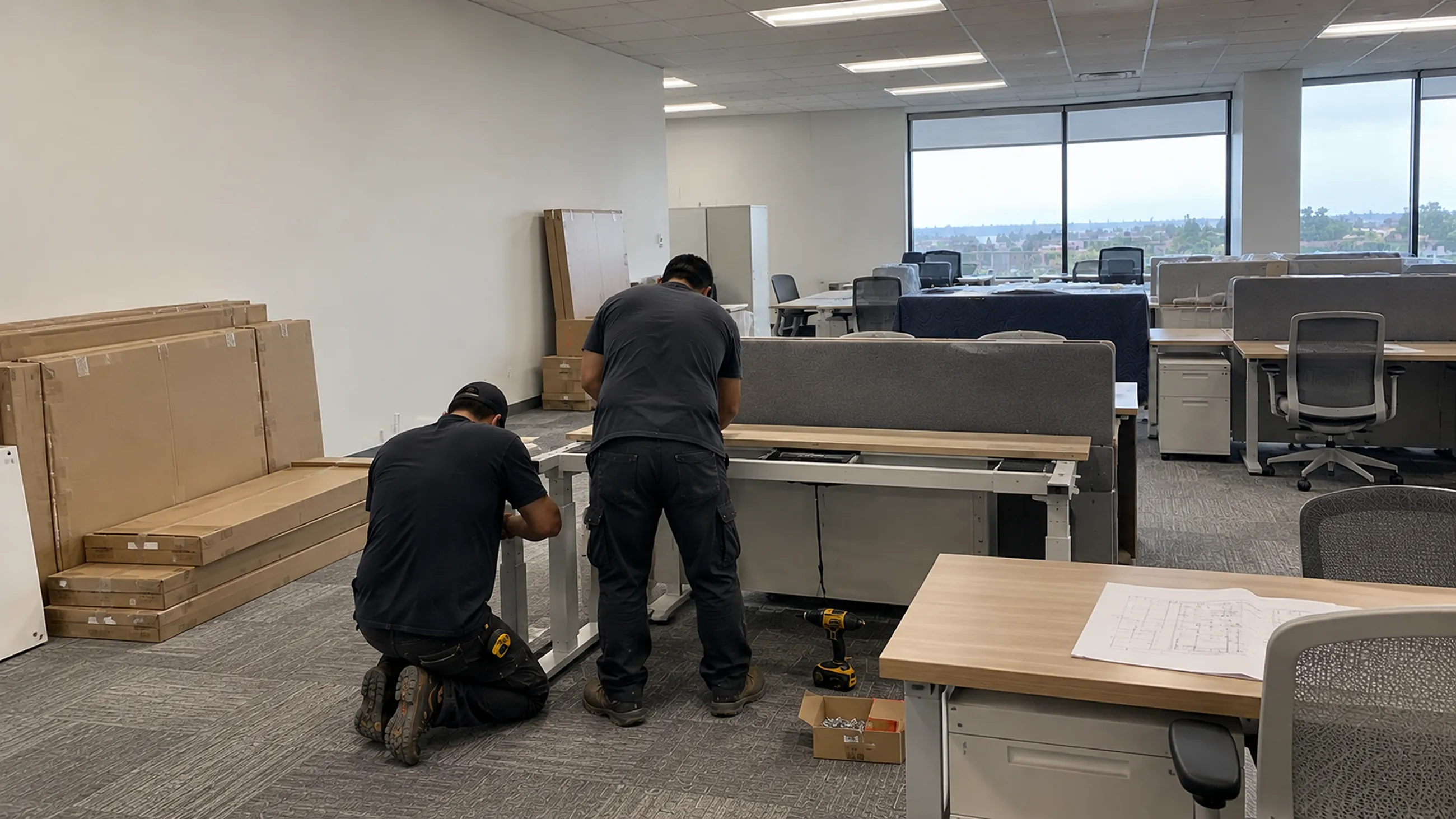
Office furniture installation cost comes down to labor hours, crew size, and how hard the building makes the work. Published national guides commonly quote $35 to $150 an hour per installer. Commercial office furniture installation is often priced by the workstation or as a project line item instead. Neither number means much until you know what is inside it.
Those national figures are not San Diego quotes, and many come from guides that blend commercial and residential work. This guide explains how installers price, how per-workstation math works, what moves your office furniture setup cost up or down, and what a written quote should spell out, so you can compare bids on the same footing.
Four ways installers price the job
Installation is usually priced one of four ways. Each suits a different kind of job.
Hourly rates
- You pay for crew time.
- Published guides commonly show $35 to $150 an hour per installer, with the spread driven by location, skill, and scope.
- Best for small or unpredictable jobs.
Per-workstation pricing
- One price for each workstation set.
- Makes a large order easy to compare and budget.
- Best for repeating layouts with a clear workstation count.
Per piece
- A flat price for each desk, table, or cabinet.
- Often comes with a discount as the count goes up.
- Best for mixed orders with a handful of different items.
Project or lump sum
- One price for the whole install, usually set after a site walk.
- The scope is written out, so changes are easy to spot.
- Best for full buildouts and phased move-ins.
The method matters less than what it includes. An hourly rate that covers receiving, assembly, placement, and debris removal can cost less than a lower rate that covers assembly only.
What an hourly rate actually pays for
Office furniture installation rates are quoted per hour, and the hourly rate on a quote is well above what the installer takes home. California office furniture installer listings pulled in October 2026 show wages of roughly $18 to $30 an hour. The billed rate is higher because it also carries payroll taxes, workers' compensation, liability insurance, trucks, tools, supervision, and margin. A rate that looks high next to a wage is often ordinary once those are counted, and a rate that looks low may be leaving some of them out.
Four things change what an hourly quote actually costs:
- Crew size. The published rate is usually per installer. A three-person crew is three times the hourly number.
- Minimums. Many installers set a minimum charge of a few hours per visit, which matters on small jobs.
- Travel and mobilization. Some add a trip or setup charge, others fold it into the rate.
- Overtime and off-hours. Evening and weekend work often bills higher.
Hourly pricing fits best when the scope is small or uncertain, such as adding a few pieces to an existing office. For a full buildout, it leaves the risk with you, because every surprise is billable time. That is why larger jobs usually move to a per-workstation or lump-sum price.
How per-workstation pricing is built
Per-workstation pricing is the same labor math, packaged. An installer estimates how many labor hours one workstation takes, multiplies by the crew rate, adds the job-level costs, and divides by the workstation count.
To show the math, here are made-up round numbers. They are an illustration, not a quote and not a Beckon rate. Say three installers at $75 an hour each work two eight-hour days to set 20 workstations. That is 48 labor hours, or $3,600, which works out to $180 per workstation before any extras.
The most useful question to ask an installer is how many labor hours they budget per workstation, and with what crew. That answer lets you compare quotes. The same workstation count can mean very different work:
- Benching and open-plan desks. Repeating layouts go in quickly once the crew has a rhythm, and the main variable is cable management and any shared power.
- Panel-based systems. Panels, work surfaces, and storage connect in sequence, so these take longer and need a careful read of the plan.
- Height-adjustable desks. Frames, motors, and control paddles add assembly time and testing.
- Private offices and casegoods. Credenzas, bookcases, and wall-hung units are fewer pieces but slower ones, and some need anchoring.
- Conference and training tables. Large tops often need extra hands and floor protection, and alignment takes time.
A per-workstation figure for one type will not carry over to another. If your office mixes them, ask for the quote broken out by type.
What drives office furniture installation cost from quote to quote
Most of the variation between two quotes for the same furniture comes from the site more than from the product. These are the factors that move the number.
- The site walk. Installers price what they can see. A quote written from a floor plan alone leaves room for change orders.
- Access. Loading dock or street unload, elevator reservations, stair carries, and how far the furniture travels from truck to floor all add time.
- Building rules. Many buildings limit delivery hours, require freight elevator booking, and ask for a certificate of insurance before work starts.
- Schedule. Evening or weekend installs, tight deadlines, and phased move-ins change the labor plan.
- Receiving and inspection. Counting cartons, checking for damage, and staging product by zone takes real hours before assembly starts, and pieces bought used instead of new add a check for missing parts.
- Complexity of the product. Systems furniture, motorized desks, and large tables take longer than loose chairs and standard desks.
- Debris removal. Cartons, foam, and pallets add up fast on a large order. Confirm whether removal is in the quote.
- Floor protection and punch list. Protecting finished floors and fixing small defects after install both take time.
- Project management. A coordinator who sequences deliveries and crews is a real cost, whether it is itemized or built into the rate.
Power and data hookups are a separate trade in most offices. An installer places furniture, and an electrician or low-voltage contractor handles the wiring, so ask whose job each connection is. Installation also has to sit on the same office move checklist as the lease dates and the movers, because a crew booked late can cost more or push the move-in date.
What to get in writing before the crew shows up
A vague quote is where cost surprises begin. Before you accept one, ask that it state:
- Scope. Which pieces are included, by location or zone, and who unpacks, assembles, places, and levels them.
- The pricing method. Hourly with an estimate and a cap, per workstation, per piece, or lump sum.
- Crew size and labor hours. So you can compare bids on the same basis.
- Minimums, trip charges, and any other installation fee. Listed on the quote, so they never first appear on the invoice.
- Off-hours and overtime terms. Including what triggers them.
- Debris and packaging removal. Included or extra.
- Insurance. Liability and workers' compensation coverage, and whether the installer can provide the certificate your building asks for.
- Change and delay terms. What happens if the delivery arrives late, short, or damaged.
- Punch list and warranty on the work. Who comes back to fix issues, and for how long.
- Itemized labor. Installation labor listed apart from the furniture, which also matters for tax.
How California taxes installation
California treats furniture and installation labor differently. The furniture itself is generally taxable. Installation labor generally is not taxable, and the state's guidance says it should be itemized on the invoice. Materials supplied as part of the install, such as bolts, screws, and cables, are generally taxable. The rule sits in Regulation 1546, which also covers when an installer counts as the retailer of the parts they furnish.
The practical point is that an invoice with one lump figure for furniture and labor can make it harder to see what was taxed. Ask for installation to be a separate line. This is general information, not tax advice, so confirm how it applies to your invoice with your CPA.
Where the savings are
The biggest savings come from planning, because every change after the order costs crew hours.
- Settle the layout before the order. Moving a workstation on install day costs crew hours. A plan that has been checked against the floor avoids it.
- Receive everything in one place. Scattered deliveries mean repeated handling and repeated crew time.
- Order a matching, reorderable product line. Consistent pieces install faster than a mixed set.
- Prepare the space. Clear floors, working elevators, and open access cost nothing and save hours.
- Bundle the work. Delivery, installation, and removal of old pieces done by one team avoids duplicate trips, and it keeps decommissioning the old space on the same schedule as the new install.
- Watch for rework. Damaged or missing parts found at install cost more than the same problem found at receiving.
The plan sets the price before the crew arrives
Installation cost is shaped long before the crew arrives. A furniture plan that has been measured against the actual floor, with clear workstation counts and zones, gives an installer something precise to price. A loose plan gives them risk to price instead, and risk costs money.
That is the reason Beckon treats installation as part of the furniture project, with one team handling moving, decommissioning, and installation. The installers receive, inspect, stage, assemble, install, and place your commercial furniture according to the approved plan. Qualifying furniture projects also come with complimentary design services, including installation plans that make sure everything fits, so the layout is settled before the first carton opens.
THE BECKON BACK PHILOSOPHY
A great space is one people want to come back to. Furniture that arrives on time, goes in where the plan says, and works from day one is part of that. Installation is the last mile, and it shapes how the whole project feels.
Frequently asked questions
How much does furniture installation cost for a commercial office?
It depends on the pricing method, the amount of furniture, and the site. Published national guides commonly quote $35 to $150 an hour per installer, and commercial jobs are often priced per workstation or as a project total after a site walk. Those figures are not San Diego quotes, so ask for a written quote based on your floor plan and building access.
How much do office furniture installers charge per hour?
Published guides commonly show $35 to $150 an hour per installer. The rate varies with location, crew skill, and what it includes, such as insurance, tools, and supervision. Ask whether the rate is per installer or per crew, and whether a minimum charge applies.
What does furniture installation cost per workstation?
There is no single figure, because a bench desk, a panel-based system, and a height-adjustable desk take different amounts of time. Ask the installer how many labor hours they budget per workstation and with what crew size, then compare bids on that basis. The calculation is labor hours times the crew rate, plus job-level costs, divided by the workstation count.
Is installation included in the price of commercial furniture?
Sometimes, but not by default. Some dealers include delivery and installation in a project price, and others quote furniture only and bill installation separately, which is also worth asking about when you price office chairs in San Diego. Ask for the two as separate lines so you can see what you are paying for and compare quotes.
Is furniture installation taxable in California?
Installation labor is generally not taxable in California, while the furniture itself and materials supplied for the install generally are. State guidance says labor should be itemized on the invoice. Confirm how it applies to your invoice with your CPA.
Should we install the furniture ourselves?
For a few simple pieces, it can work. For workstations, panel systems, or motorized desks, professional installation usually saves time and avoids assembly mistakes, and some manufacturers set installation requirements in their warranty terms, so check yours first. Staff time spent assembling furniture is also time not spent on work.
How can we reduce installation costs?
Settle the layout before ordering, receive deliveries in one place, prepare the space so crews have clear access, and bundle delivery, installation, and old-furniture removal with one team. Ask for a written quote that lists scope, crew size, minimums, and debris removal so nothing is added later.
Does Beckon install commercial office furniture?
Yes. Beckon's installation team receives, inspects, stages, assembles, installs, and places your furniture according to the approved plan. Qualifying furniture projects include complimentary design services, with installation plans that make sure everything fits. Beckon starts from your floor plan and headcount, and you can share both with the team to get going.
Ready to plan your installation?
Tell us about your space, your headcount, and your timeline, and we will help you plan the furniture and the install together.